

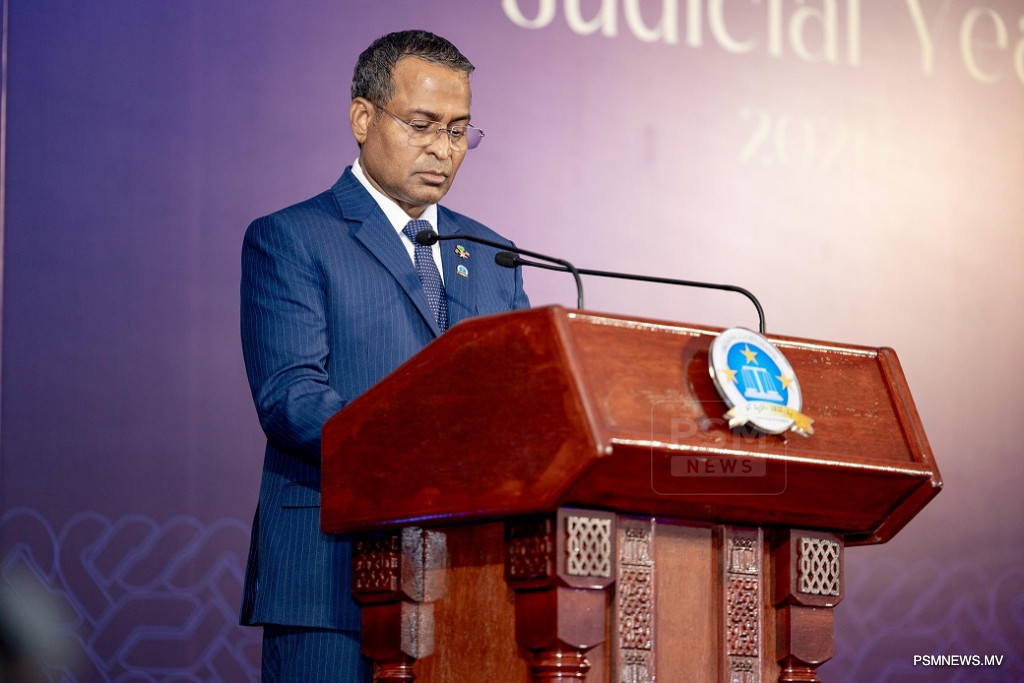
Chief Justice Abdul Ghanee Mohamed has described the government’s budget allocation for the judiciary in 2026 as promising, saying it provides a strong foundation to advance reforms, strengthen independence and accelerate digital transformation within the justice system.
Speaking at a ceremony marking the start of the Judicial Year 2026, Abdul Ghanee Mohamed outlined key priorities for the year ahead, including major steps to digitalise court processes under the Maldives 2.0 initiative.
He said the current administration is working to remove long-standing obstacles that have hindered the judiciary for years, noting that the dedicated budget allocation reflects the government’s commitment to safeguarding judicial independence and delivering tangible improvements.
According to the Chief Justice, 49 new Public Service Investment (PSI) initiatives are scheduled to begin this year, alongside the completion of 10 ongoing projects aimed at strengthening judicial infrastructure and services.
As part of the digitalisation drive, he said the Department of Judicial Administration has begun modernising criminal and debt record clearance by establishing a dedicated digital database. The reform will replace a manual system that has been in place for decades.
“With the completion of this work, a process that previously took seven days will be reduced to just one day,” the Chief Justice said.
He added that a new application is also being developed to digitally document submissions and discussions presented by both sides in cases before the Judiciary Committee. In addition, an Integrated Case Management Module is expected to be introduced in all courts in the Malé region by June, with plans to extend the system to densely populated islands in the atolls thereafter.
The Chief Justice said these initiatives are intended to improve efficiency, transparency and accountability across the judiciary, and to ensure the justice system delivers timely and effective outcomes for the public.