

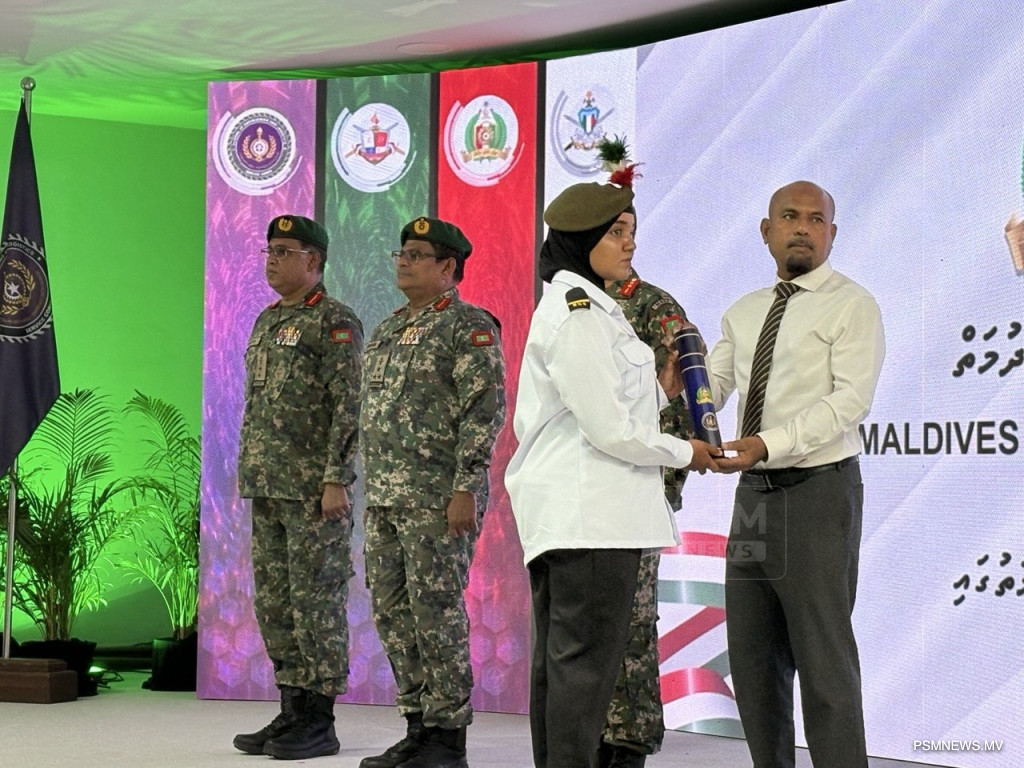
The National Service Programme reached a significant milestone as sixty-three participants successfully graduated from the first batch of the National Service Technical Training Programme.
The graduation ceremony, held at the School of Engineering and Logistics in Kihaadhoo, Baa Atoll, marked the culmination of a rigorous four-month intensive training initiative designed to equip young Maldivians with valuable professional skills. These graduates represent the first cohort of National Service Initial Training students who expressed interest in pursuing specialised technical education, having been selected from a larger group of participants who completed their foundational training.
The technical training programme attracted considerable interest across the archipelago, with sixty-five youths from thirty-five islands spanning fifteen atolls of the Maldives initially enrolling in the programme. Of these, sixty-three participants successfully completed the requirements for graduation, demonstrating remarkable dedication and commitment to their professional development.
The programme's comprehensive curriculum covered six primary technical disciplines, including Electrician training, Automobile Engineering, Marine Engineering, Refrigeration and Air Conditioning, Office Management, and Building and Fabrication. Upon successful completion, all graduates received a minimum of a Level 3 certificate, providing them with recognised qualifications that will enhance their employment prospects and contribute to the nation's skilled workforce.
The National Service Technical Training Programme represents a cornerstone initiative of the government under the leadership of President Dr Mohamed Muizzu, aimed at building a patriotic, spiritually and mentally healthy generation of young Maldivian citizens.
According to the Minister of Defence and National Service, Hassan Rasheed, who addressed the graduating cohort at the ceremony, the programme's fundamental objective is to cultivate a strong young generation that is well-acquainted with professional work environments and equipped to serve the nation competently. The Minister emphasised that the programme goes beyond mere skills training, seeking to instill values of responsibility, integrity, and civic-mindedness in all participants.
During his address, Minister Hassan Rasheed extended his congratulations to the graduates while highlighting the broader significance of their achievement. He noted that students from diverse geographical locations across the Maldives had participated in the programme, underscoring its national scope and accessibility. The Minister attributed the programme's success in large measure to the trust placed by parents in allowing their children to participate in this national initiative. He encouraged the graduates to leverage their newly acquired skills in service to the country, emphasising that they would become young professionals capable of providing skilled and responsible contributions to society.
The Minister used the occasion to relay a recent incident on a speedboat carrying female students who had completed their training in Maafilaafushi, citing it as compelling evidence of the programme's effectiveness in developing practical competencies and character.
According to Minister Hassan Rasheed, when faced with an emergency situation, the trained students demonstrated remarkable composure, avoiding panic while applying their training collaboratively until help arrived. This real-world demonstration of the programme's value reinforced the Minister's assertion that such initiatives are essential for building skilled and responsible youth who can serve the nation effectively in various capacities.
The graduation of this first cohort follows the completion of the initial round of basic National Service training on 28 December of last year, during which three hundred forty-four participants completed their foundational instruction.
Of that initial group, the sixty-three graduates now celebrated represent those who elected to pursue advanced technical specialisation. Meanwhile, the second round of basic National Service training has also concluded, with three hundred fifty participants enrolling and three hundred forty-three successfully completing the programme. Eighty participants from this second round have been selected to undertake the technical training programme, ensuring that the initiative will continue to expand its impact in the coming period.