

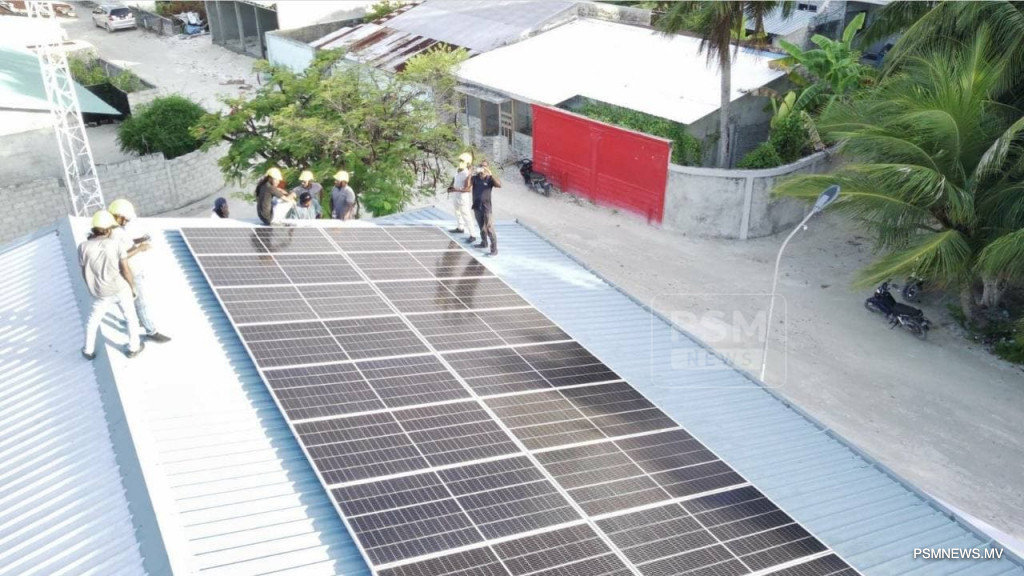
In a major stride toward sustainable energy and economic resilience, the Maldives has begun switching off diesel generators on several of its islands, transitioning instead to newly installed solar photovoltaic (PV) hybrid systems.
As an archipelagic nation, the Maldives faces unique logistical challenges, with electricity provision being one of the most expensive basic services for the government to maintain. Currently, the country’s heavy reliance on imported fuel for electricity generation is a major economic vulnerability, draining an estimated 13 percent of the nation's Gross Domestic Product (GDP) on fuel imports alone.
To mitigate this massive financial burden and combat climate change, the government has set an ambitious target to generate 33 percent of the country’s electricity from renewable sources by 2028.
The tangible results of this initiative are already being felt in Raa Atoll and Baa Atoll. Under a landmark project funded by grants from the Asian Development Bank (ADB) and the European Investment Bank (EIB), a total of 6.5 megawatts (MW) of solar power has been rolled out across 25 islands in these two atolls. On these islands, diesel engines are now being shut down for most of the day, with entire communities running entirely on clean, solar energy.
Highlighting the success of the project during a visit to the island of Kudarikilu, Minister of Climate Change, Environment and Energy, Ali Shareef, emphasised the profound economic and environmental significance of the milestone.
"I am at the Kudarikilu power plant. I am giving this interview because the engines are off," Minister Ali Shareef said, pointing out that the island's diesel generators are successfully shut down from 8:00 am to 3:00 pm daily.
"The whole island was supplied with electricity by newly installed solar panels and batteries with the help of the battery energy storage system."
The transition to solar-diesel hybrid systems is expected to drastically reduce the country's dependence on imported fuel, allowing the Maldives to retain vital foreign exchange reserves within its domestic economy and heavily boosting its overall financial health.
According to the government, the transition is about much more than just saving fuel. It represents a vital investment in protecting the Maldives’ fragile marine and island ecosystems from the threats of climate change, while securing a self-sufficient, sustainable, and brighter future for generations to come.