

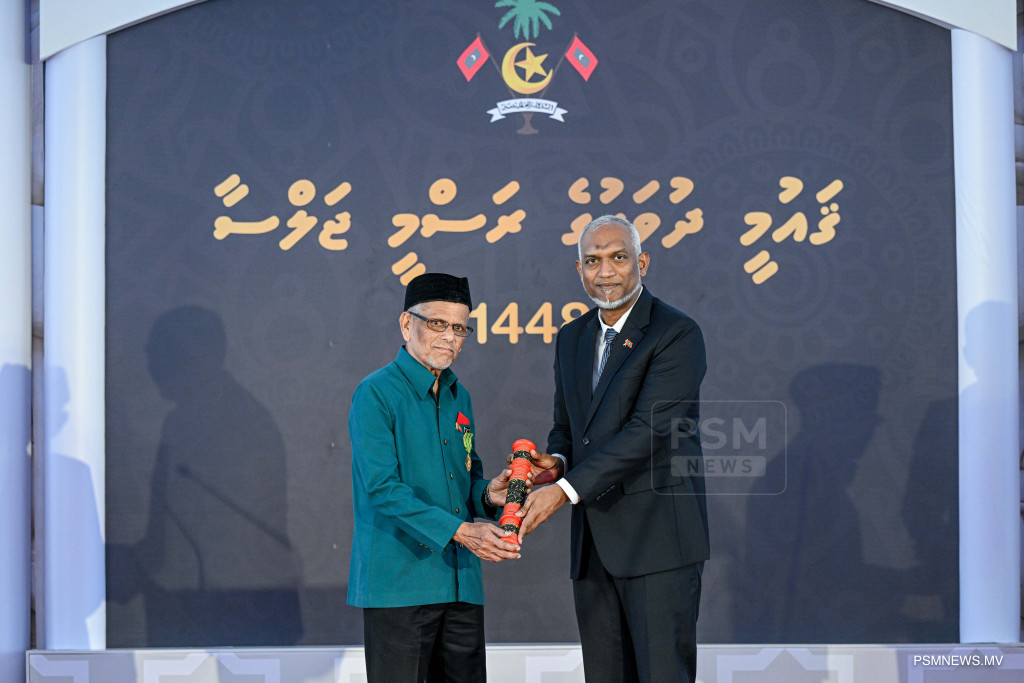
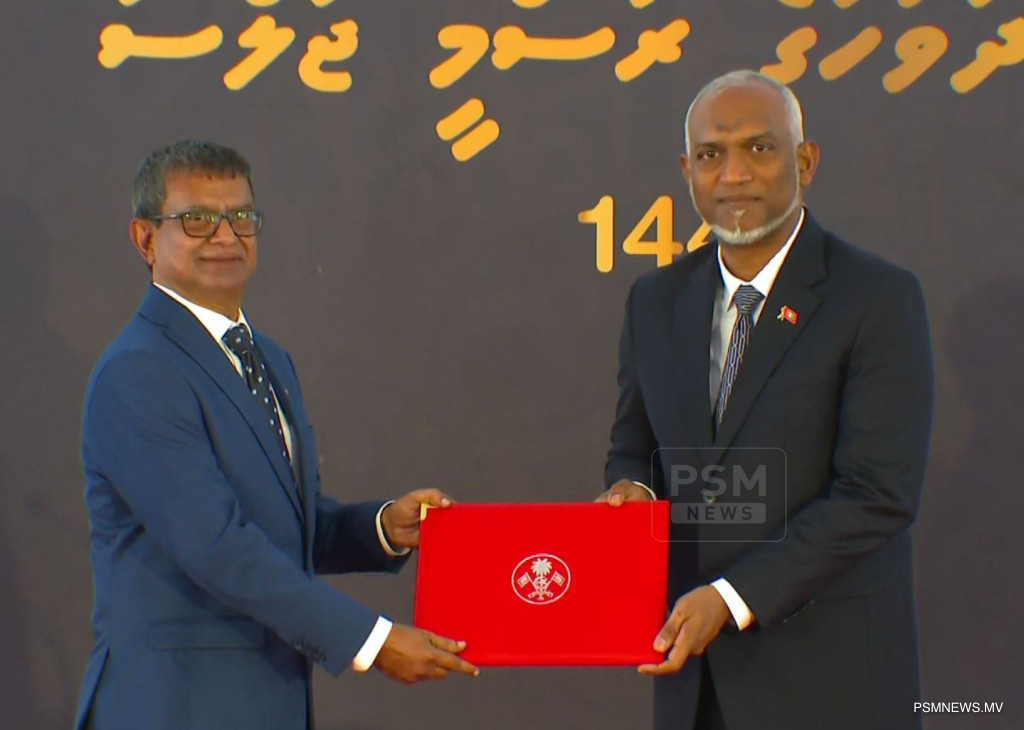
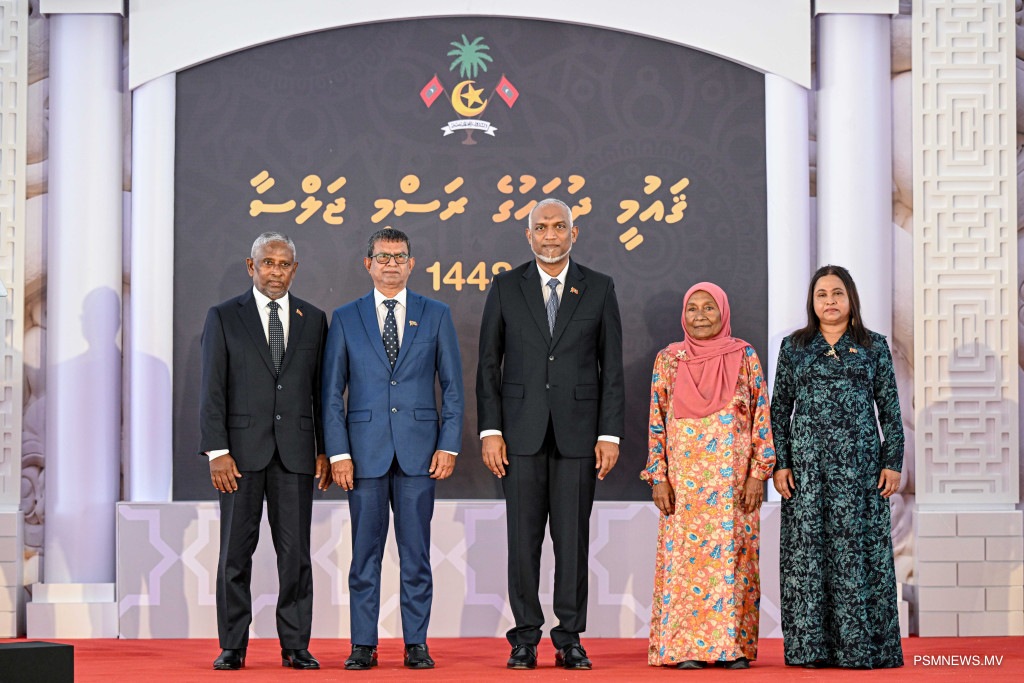
President Dr Mohamed Muizzu has conferred the prestigious Order of the Dignified Rule of the Dhiyamigili Dynasty upon Ahmed Shakir for more than four decades of public and literary service, and the National Award of Honour upon Mohamed Amir Ahmed for his contributions to Dhivehi literature, at the official National Day ceremony in Utheemu, Haa Alifu Atoll. The honours, presented by President Muizzu, celebrated the profound contributions both men have made toward preserving the nation’s language, culture, and historical record.
A four-decade career spanning state service, stagecraft and historical scholarship
Ahmed Shakir entered public service on 30 July 1969, taking an entry-level post at the Government Printing Press. The institution served as an intellectual hub for emerging writers, allowing him to work alongside prominent intellectuals such as Abdulla Sodiq, Ali Fahmy, Alibedhokhokko Dhon Alifulhu, and Mohamed Sodiq, through whom he studied the formal vocabulary and phrasing of the Dhivehi language. By the early 1970s, he was selected as one of five state officials dispatched aboard the Hoko Maru No. 56, a vessel operated by the Japanese Marubeni Corporation to purchase raw fish in the Maldives. Aboard the ship, he taught himself Japanese and translated the English romance novel ‘Give Me Back My Heart’ into Dhivehi, a work serialised in the daily newspaper ‘Viyafaari Miadhu’ before mechanical trouble curtailed the vessel’s deployment.
Upon returning to Malé, Shakir joined the ‘Athiree Maafannuge Trading Account’, an entity administered under the direct supervision of President Ibrahim Nasir, before being appointed secretary of the accounts division at the MGBS. His public profile widened in April 1977 during the golden jubilee celebrations of Majeedhiyya School, where his stage roles in productions such as ‘Thin Undhagoo’, including the portrayal of a senior Portuguese officer and comic characters, drew the attention of President Nasir. The president enlisted him into the ‘Olympians’ troupe, where he performed alongside actors such as Moosa Manik, Mohamed Rasheed, Mohamed Shahid Haleem, and Ibrahim Moosa.
Following the conclusion of the Olympians era, Shakir co-founded the Cultural and Dramatic Society, staging annual productions at the Olympus theatre across a decade. Joining Television Maldives as a programme producer, he wrote screenplays, developed tele-dramas, and narrated documentaries. In the early 1980s, he portrayed Hassan Thakurufaanu in the television film ‘Ghaazee Bandaarain’, drafting the screenplay for its second episode and instructing the cast. He subsequently scripted numerous productions, including ‘Dhon Hiyala aai Alifulhu’, ‘Hithi Dollar’, ‘Baraabaru Agent’, ‘Maamui Handhu’, ‘Mushun Dhoovi Gumree’, and ‘Tharaaganduge Kashigandu’.
Shakir’s historical documentation expanded when President Maumoon Abdul Gayoom commissioned him to record the twentieth-century history of the Maldives. He contributed to the official chronicles of the first 15 years of the Gayoom administration and authored the 640-page volume ‘Maldives in the Twentieth Century’, alongside five related volumes. His state bibliographies encompass institutional histories written for the Ministry of Islamic Affairs, the Department of Judicial Administration, the Maldives Monetary Authority, the Ministry of Finance, state radio services, airports, the audit office, STELCO, and various island communities, as well as biographies of President Mohamed Ameen, President Ibrahim Nasir, Umar Zahir, Abdulla Sodiq, and Ibrahim Naeem.
Between 2014 and 2015, Shakir helped structure the Maldives Hajj Corporation and accompanied pilgrims overseas. While teaching undergraduate and postgraduate courses at Villa College, he completed a Bachelor of Laws and earned a Master of Shariah at age 69. Over a 41-year public career ending with his retirement in 2010, he served as Attorney at the Ministry of Transport and Shipping, Shipping Master, Director of Administration, and Director General of both the transport department and the National Center for Linguistic and Historical Research. His previous honours include the National Award of Recognition for acting in 1985, the President’s Silver Pen for journalism in 1993, the National Award of Recognition for oratory in 2002, the National Award of Honour for historical compilation in 2016, the Hassan Thajuddin Award in 2017, and the ‘Al-Rawi’ title at the Sharjah International Narrator’s Forum in 2025. He currently serves on the ‘Dhivehi Qaumiyyathuge Isvaru’ and chairs the National Awards Committee.
A commitment to Dhivehi language education, national curricula and verse
Mohamed Amir Ahmed, recipient of the National Award of Honour, began his formal literary training in 1988 under the mentorship of the late poet Yoosuf Mohamed Fulhu through courses held by the National Center for Linguistic and Historical Research. Amir subsequently conducted complimentary poetry workshops in schools and taught across 16 Dhivehi language degree courses at the Maldives National University, where he authored 11 academic papers on poetic structure and codified grammatical principles from ‘Naibu Thuththu’ regarding ‘Dhiyoage Raivaru’.
During an approximate 17-year tenure at the Educational Development Centre, Amir drafted national syllabi, teacher manuals, and textbooks for Grades 5, 8, 9, and 10, alongside specialised literature curricula for higher secondary levels. An editor and journalist, he gained recognition after winning accolades across multiple categories at the inaugural National Poets’ Day. He served on the Dhivehi Language Committee between 1989 and 2022 and has sat on the Dhivehi Grammar Committee since 2014. His prominent published poetry includes the song ‘Isnagaashey Dharinnay Zuvaan’, composed for the Maldives National Defence Force, and ‘Karunayaai Leyge Thoofaan’, concerning the plight of children in Gaza. Amir, who previously received the National Award of Recognition for Dhivehi poetry in 1996, currently serves as Director General of the National Archives of Maldives.
National honours presented across civic, cultural and technical fields
During the ceremony, President Muizzu presented the National Award of Honour to three individuals and one organisation, alongside the National Award of Recognition to eight individuals and one company. The National Award of Honour was also conferred upon Ibrahim Rasheed for achievements in construction and architecture, Najma Hussain for contributions to news and information dissemination, and the Society for Health Education for service to the health sector.
The National Award of Recognition was bestowed upon Hawwa Latheef for religious education and Islamic awareness; Mohamed Naseer for Dhivehi language and literature; Command Sergeant Major Abdulla Saeed for historical research; Mohamed Ahmed for healthcare contributions; Bison Maldives Private Limited for construction and architecture; Arushad Ahmed for communications and information technology; Aishath Naura for sports; and Ismail Abdul Ghafoor for visual arts. The honour was also conferred posthumously in memory of the late Ihusan Abdul Ghanee.