

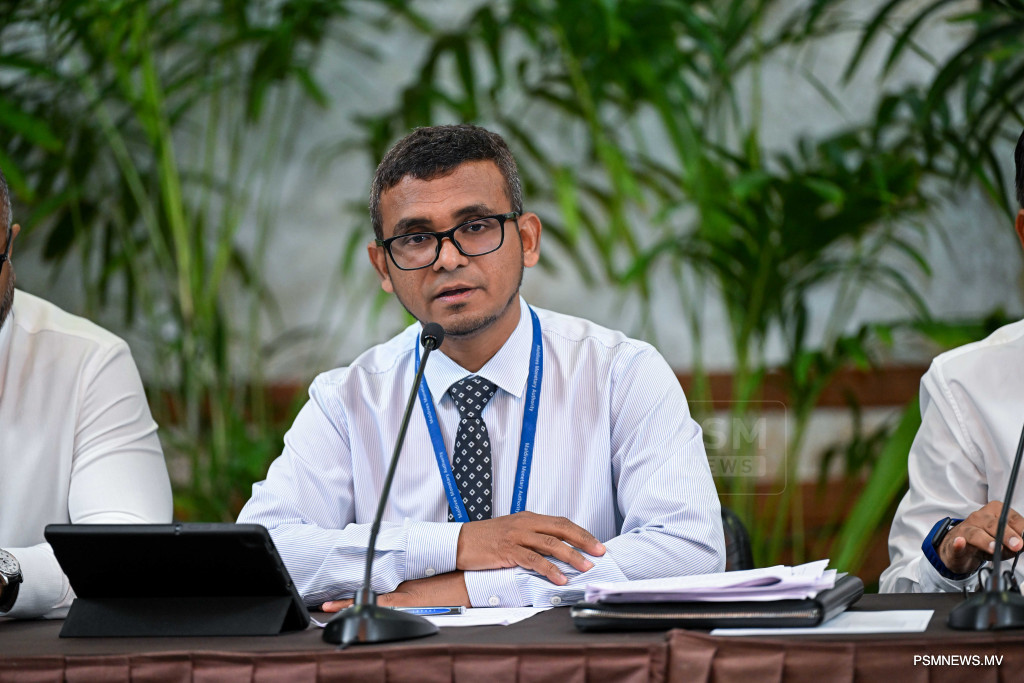
Governor of the Maldives Monetary Authority (MMA) Ahmed Munawar has said many parties earning significant income in foreign currency are circulating large sums through the black market using money changers.
Governor Munawar made the remarks while speaking at a press conference held at the President’s Office.
Highlighting recent economic developments, Governor Munawar said economic indicators showed that the conflict in the Middle East slowed the Maldives’ economic activity during March and April this year. Compared with other crises, he said the conflict affected the Maldivian economy on two fronts.
Munawar said the conflict reduced tourist arrivals while placing significant pressure on the Maldives due to the country’s reliance on imports for goods and fuel. Although the conflict has yet to end completely, he noted that recent figures show a significant recovery in the tourism sector.
Reflecting this recovery, the latest statistics show that although overall tourist arrivals declined, tourism revenue increased by one per cent. Banking sector figures also show that foreign currency income, bank deposits and credit recorded growth of 18 per cent.
Turning to the country’s official reserves, Governor Munawar said the conflicts in the Middle East and Ukraine had pushed fuel prices to more than double their previous levels, significantly increasing fuel expenditure. He added that MMA continues to undertake significant efforts to increase official reserves.
Despite the improving economic indicators, Goveror Munawar said black-market activity had increased significantly over the past month. While the conflict in the Middle East temporarily disrupted the dollar market, he said there was no reason for the black market to expand to its current extent.
In response, the Governor said MMA is conducting monitoring operations specifically targeting money changers. Studies conducted in coordination with enforcement agencies found that many parties earning significant income in foreign currency are circulating large sums through the black market using money changers.
To address the issue, Munawar said authorities have decided to conduct the necessary investigations to stop these activities and enforce the law. He added that the MMA has already suspended the operations of one money changer after finding that it had acted in violation of regulations.
MMA aims to shift financial transactions to local currency by 2030
Governor of the Maldives Monetary Authority (MMA) Ahmed Munawar has said the central bank aims to transition financial transactions in the Maldives to the Maldivian rufiyaa by 2030.
Speaking at a press conference held at the President’s Office, Munawar said the MMA plans to introduce changes to shift financial transactions towards the local currency. He noted that a significant number of financial transactions in the Maldives currently take place in US dollars and said the MMA aims to complete the transition by 2030.
Munawar said the Maldives should become a country where all transactions take place in Maldivian rufiyaa, noting that previous MMA governors had also pursued the same objective.
As part of this transition, the Governor said changes would also need to address the payment of salaries in US dollars. Citing Trans Maldivian Airways (TMA) and resorts as examples, he said shifting such payments away from the dollar would increase demand for the Maldivian rufiyaa.
Governor also identified tourism-sector land rent as another area requiring change, noting that the sector currently pays land rent owed to the Government in foreign currency. He said the use of foreign currency in the Maldives currently stands at more than 40 per cent.
Alongside measures to increase the use of the rufiyaa, Munawar said the country would also need broader macroeconomic reforms, including measures to stabilise budgetary policy. He said the MMA ultimately envisions a managed float system for the Maldives, which would require the central bank to maintain adequate reserves.
As part of wider foreign currency reforms, the Governor said authorities have decided to propose further amendments to the Foreign Currency Act to increase the proportion of resort dollar revenue that must be exchanged from 20 per cent to 40 per cent. He said the proposed amendments would also shorten the period for exchanging dollars from three months to one month and introduce a mechanism to monitor how businesses spend income earned in US dollars.
The Government recently proposed another amendment to the Foreign Currency Act to remove the option allowing resorts to exchange USD 500 per tourist and instead require them to exchange 20 per cent of their revenue.
The bill also aims to ease foreign currency exchange requirements for businesses wholly owned by Maldivians, excluding tourism businesses and financial institutions. It also seeks to address difficulties businesses face in exchanging foreign currency within the amount and timeframe required by law.
Under the proposed amendment, parties selling goods or providing services in the tourism sector would have to deposit their foreign currency income into a bank account. Other parties that received the equivalent of at least USD 25 million in foreign currency from goods sold or services provided during the previous calendar year would also have to deposit their foreign currency income into a bank account.
The existing law sets this threshold at USD 15 million.