

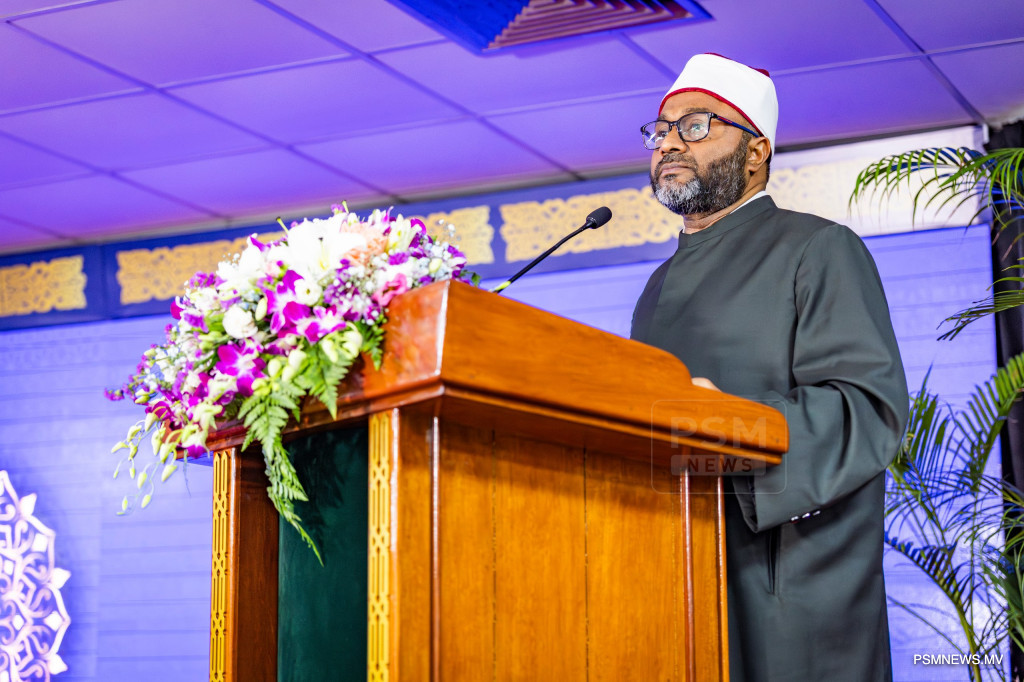
Minister of Islamic Affairs and Endowments, Dr Mohamed Shaheem Ali Saeed, has urged newly graduated young khateebs to view their certification not as a final achievement, but as a stepping stone toward continuous learning and lifelong community service.
Speaking at the official certificate awarding ceremony for the 5th batch of the Young Khateebs Training Programme, Minister Shaheem emphasised that the ability to deliver sermons is a noble skill that enhances a person's character and carries a responsibility that lasts a lifetime.
"A khateeb is a leader—a leader who stands like a clear moon on the front lines of Islamic teachings and values. They must serve as a role model for others,” he said.
The Minister encouraged the young graduates to extend their presence beyond just Friday prayers by regularly leading congregational prayers and setting a positive example for Maldivian youth.
Addressing the core objective of the initiative, Minister Shaheem highlighted a pressing national need—the historical generation of imams who served across the country for decades is gradually retiring, leaving some islands reliant on traveling khateebs to conduct Friday prayers. The Young Khateebs Training Programme was specifically designed to bridge this gap, having successfully produced over 700 young religious leaders to date.
Minister Shaheem reassured the public regarding the capability of these young graduates, pointing to the strength of the national Islamic curriculum. He explained that students completing Imam Certificate Levels 1, 2, and 3, alongside secondary school studies in Hadith, Quranic studies, history and civilisation are fully qualified to carry out imam duties.
"Failing to build this generation today would pose serious challenges for the Maldives' future," the Minister warned, adding that this newly cultivated generation will carry forward Islamic values for the next century.
The 5th batch of the initiative saw 91 young participants complete their training. Targeted at students in Grades 10, 11, and 12, as well as school leavers under the age of 18, the programme has surged in popularity across the country, breathing renewed energy and youth involvement into religious outreach across the archipelago.