

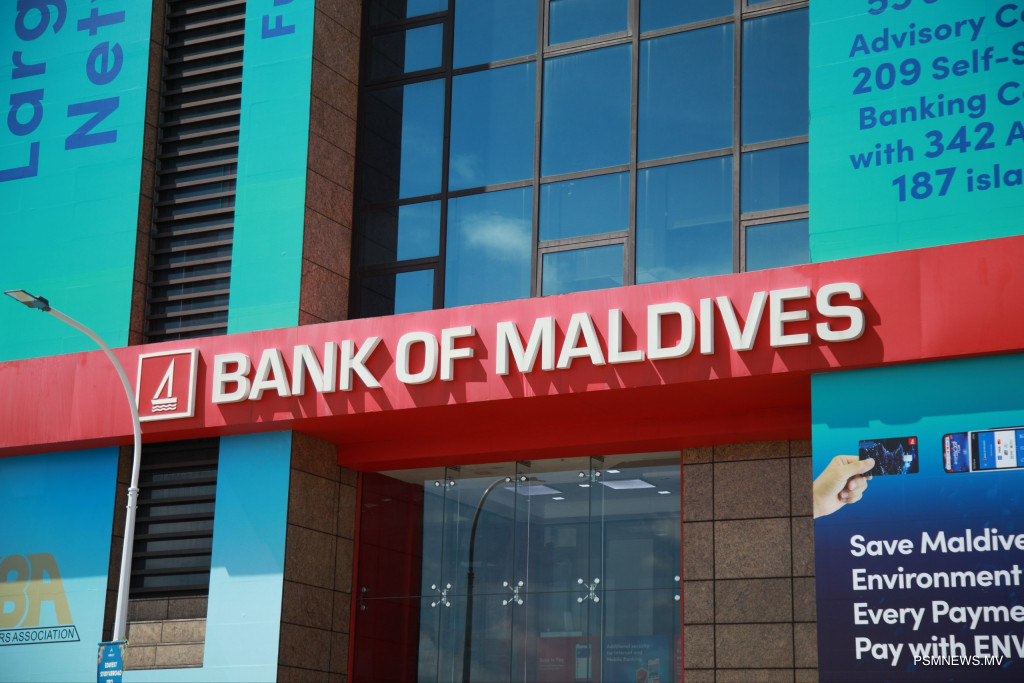
Bank of Maldives (BML) has rejected recent claims suggesting that the repayment of a government Treasury Bill and the bank’s financial position are linked.
The government repaid the final USD 50 million repayment under the USD 150 million T-bill facility with the State Bank of India (SBI) on 17 September.
In a statement issued regarding the payment, the bank denied that it funded or provided the US dollar liquidity for the government's repayment, or that the repayment had any impact on BML's financial position. The bank said it did not fund the repayment from customer deposits, its own resources, or any other BML funds.
The Ministry of Finance and Public Enterprises has publicly confirmed that the final USD 50 million repayment to SBI was funded from the Sovereign Development Fund (SDF). This payment completed the government's settlement of the USD 150 million T-bill facility originally obtained in 2019, following two earlier USD 50 million repayments.
BML said it continues to maintain a strong financial position and operates within its established risk appetite, regulatory requirements and robust governance and risk management frameworks. According to the bank, its liquidity, capital and financial position are continuously monitored through established management, risk management and board governance processes. BML affirmed that the repayment of its T-bill obligation to SBI was a separate transaction and did not draw on BML's financial resources or affect the bank's ability to meet its obligations to customers.
The bank fully recognised the importance of public scrutiny and informed discussion of matters concerning the country's financial system. However, it said claims concerning a bank's financial position must be based on verified facts, particularly where such claims have the potential to affect customer confidence, shareholders and the stability of the financial system. The repeated circulation of incorrect or misleading claims can create unnecessary concern among customers, businesses and investors and can undermine confidence in the bank, the broader banking sector and the Maldivian economy, it said.
BML urged all stakeholders, including public officials, political representatives and media organisations, to verify information with the relevant institutions before making or publishing claims concerning the bank, its financial position or customer funds.
Significant increase in foreign currency sales
Meanwhile, BML’s foreign-currency sales have increased significantly this year, reaching an average of USD 81.6 million per month.
In a separate statement, the bank said that by the end of August, BML had sold USD 653 million, about 33.3 percent higher than the same period last year. The bank said that If the current rate continues, dollar sales could reach around USD 1 billion by year-end.
Monthly dollar sales were mainly for:
- Debit and credit card transactions: USD 38 million
- Telegraphic transfers (TTs): USD 27 million
- Overseas travel: USD 9.4 million
- Health and education: USD 7.3 million
BML said the demand for dollars is currently higher than the supply of dollars coming into the bank, and selling dollars at the current rate is unsustainable. It noted that September is usually among the worst months in which dollar shortages are most prevalent, and that this has caused challenges to the bank.
The bank further said the imbalance has caused delays in dollar transactions, including TTs and interbank transfers, over the past two weeks. Noting that the bank has temporarily restricted some e-commerce transactions and prioritised urgent and essential transactions to manage its dollar inflows and outflows, BML said these measures have brought dollar outflows more in line with dollar inflows.
BML said it expects dollar transactions to return to normal by the end of next week. The details will be shared by the bank’s official communications channels.
The bank assured that it remains financially strong and is monitoring the situation and taking measures to protect customers, shareholders and the wider economy.