

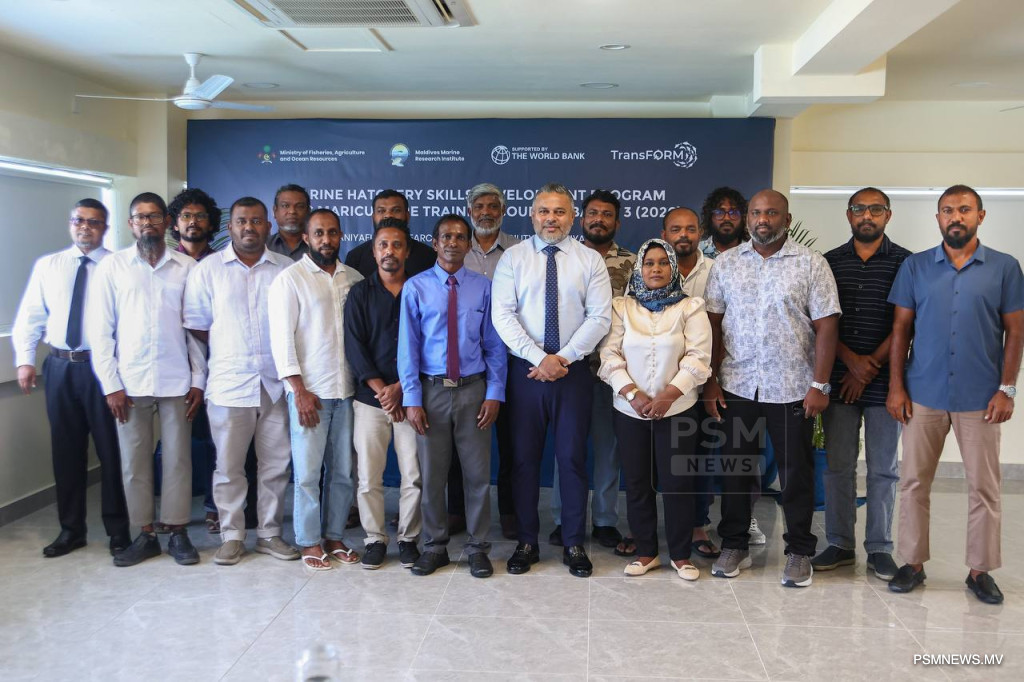
The Ministry of Fisheries, Agriculture and Ocean Resources has completed the third round of this year's Marine Hatchery Skills Development Programme.
The completion ceremony was held in Maniyafushi, Kaafu Atoll and officiated by Minister of Fisheries, Agriculture and Ocean Resources Ahmed Shiyam.
The programme trains young people in establishing hatcheries for breeding fish and developing aquaculture skills.
Its main objective is to build local expertise and lay the groundwork for a sustainable marine aquaculture industry in the Maldives.
Speaking at the ceremony, Minister Shiyam said the Government was undertaking various initiatives to develop the marine aquaculture industry. He said participants in the programme were an important part of efforts to expand the sector.
The Minister added that developing marine aquaculture as an industry could significantly reduce the range of seafood products imported into the Maldives.
He also highlighted the opportunities created by trade agreements with other countries for the fisheries and marine aquaculture sectors.
“We are signing free trade agreements with many countries, and we are now able to export without duties. One of the biggest advantages of a free trade agreement is the opportunity it creates to export our fisheries products. We must seize these opportunities,” Minister said.
The latest training course was held from 10 to 22 October at the Research and Training Facility in Maniyafushi. A total of 15 participants from various atolls took part, including one woman.
The fourth course under the programme is scheduled to be held in November and will be open to the public.
The programme is conducted by the Maldives Marine Research Institute under the Transform Project, implemented by the Ministry with support from the World Bank. It aims to develop the local expertise needed to establish and expand the marine aquaculture industry in the Maldives.
The training covers aquaculture systems, live feed production, and the breeding of species including Sea cucumber, Maldivian giant grouper, and seaweed. Participants also learn to identify and prevent diseases affecting farmed species and adopt environmentally responsible aquaculture practices. Practical experience in breeding Sea cucumber and giant grouper is also provided.
The Government has increased the annual frequency of the programme from two courses to four, beginning this year, to strengthen local capacity in the sector.
The Ministry said 91 people have been trained through the programme to date.