

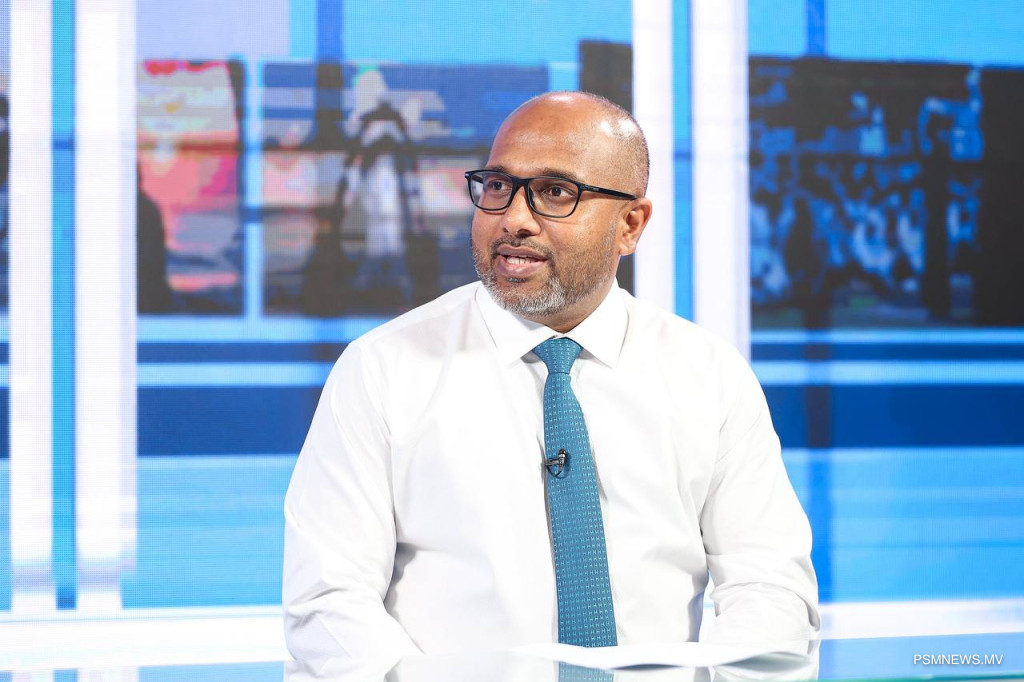
The government has unveiled a sweeping initiative to reinforce its defences against drug trafficking, announcing the deployment of a specialised container scanner for sea cargo and the consolidation of enforcement agencies, according to Minister of Homeland Security and Technology, Ali Ihusaan. Minister Ihusaan confirmed that the new scanning infrastructure will be operational within the year, part of a broader campaign to dismantle narcotics supply chains.
Speaking on a programme aired on PSM News, Minister Ihusaan outlined the administration’s dual strategy: curbing the trafficking of illicit substances while reducing domestic demand. Central to this plan is the unification of all counter-narcotics agencies under a single ministry, a directive issued by President Dr Mohamed Muizzu to streamline operations and strengthen coordination.
The introduction of the sea cargo scanner constitutes a significant enhancement in border surveillance. Minister Ihusaan noted that while air cargo had previously been subject to random screening, the government has already instituted a system in which every package arriving by air is scanned. The arrival of the container scanner later this year will extend this comprehensive scrutiny to maritime shipments, closing a critical gap in the country’s border security.
Recent enforcement measures have yielded unprecedented results. Over the past two years, authorities intercepted narcotics and alcohol valued at USD 149.16 million. Minister Ihusaan characterised this period as the most productive first two years of any administration compared with the previous three terms, projecting that the current year would deliver even stronger outcomes.
Assessing the scale of these operations, Minister Ihusaan stated: “If we look at the last two years combined, we have seized approximately 1.3 tonnes, or 1,300 kilogrammes, of narcotics,” explaining that this figure represents a street value of USD 149.16 million when including alcohol and beer. He urged the public to consider the economic and social consequences of unchecked trafficking: “Imagine if the police (Maldives Police Service), in collaboration with customs (Maldives Customs Service), had not executed this work; Maldivians would have expended this magnitude of funds on illicit substances”. He concluded by highlighting the protective role of law enforcement, noting, “Maldivians would have consumed this volume of drugs. Consequently, the police have secured a significant layer of protection for the public”.
The government is also intensifying its domestic crackdown through Operation ‘Ali Magu’, which Minister Ihusaan described as highly successful in identifying trafficking networks. The operation has already mapped illicit trade activities in Villigili in Gaafu Alifu Atoll, Fuvahmulah City, and Addu City. Following the president’s directive, authorities plan to expand the operation nationwide in the coming days.
Attention is now turning to rehabilitation. The administration is upgrading the National Drug Agency’s facilities and intends to liberalise the treatment sector this year. Minister Ihusaan announced that arrangements will be made to allow private entities to provide treatment and rehabilitation services, ensuring that these centres operate in strict compliance with international standards.