

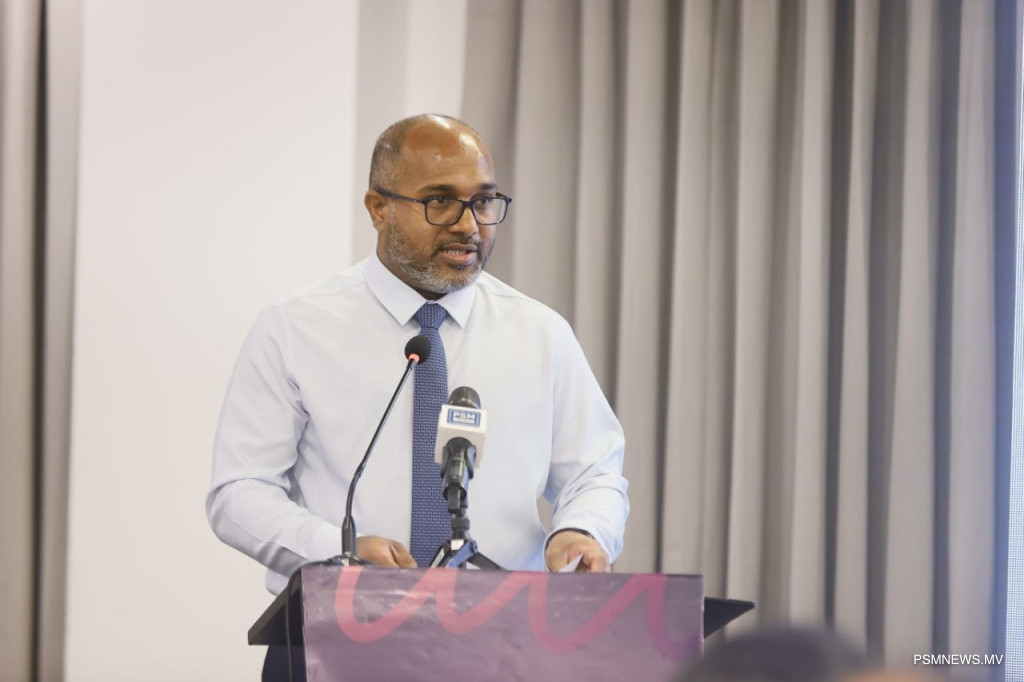
The Minister of Homeland Security, Labour and Technology, Ali Ihusaan, has warned that the nation’s ambitious digital transformation will falter unless every citizen is equipped to use new technologies safely and confidently.
Speaking at the launch of the Digital for All campaign—a cornerstone of the Maldives 2.0 roadmap, Minister Ihusaan stressed that infrastructure alone cannot drive progress.
“Technology alone cannot transform a country. We can cable every island, roll out 5G, set up digital payment systems and build platforms, but without the confidence and skills of our people we will ultimately fail,” he said.
The Digital for All initiative aims to build a skilled, responsible and productive populace that is digitally aware, enabling Maldivians to reap economic and social benefits from national digital systems and infrastructure investments.
Minister Ihusaan likened the effort to the national basic education programme launched in the 1970s that lifted literacy rates, emphasising that today’s focus must be on digital behaviour, practical skills and safe usage of emerging tools such as artificial intelligence.
He noted that virtually every sector—commerce, governance, health and education—has been reshaped by technology, with businesses increasingly becoming digital and state services migrating online. For the Maldives to grow, the Minister insisted, the country must invest not only in laying fiber and towers but also in creating digitally capable citizens who can turn those connections into opportunities.
“One of the goals of Maldives 2.0 is to build a ‘digital first’ country where no citizen’s opportunities are limited by the island they live in. That vision can only be realised if people are confidently familiar with the latest technologies such as AI or know how to navigate digital ecosystems,” he said.
The Minister announced that Digital for All will evolve into a major national‑level capacity‑building initiative reaching all atolls over the next three years. He called for broad participation—state institutions, private enterprises, local councils, women’s development committees, NGOs, leading organisations and foreign aid partners—to ensure the campaign is inclusive and leaves no one behind.