

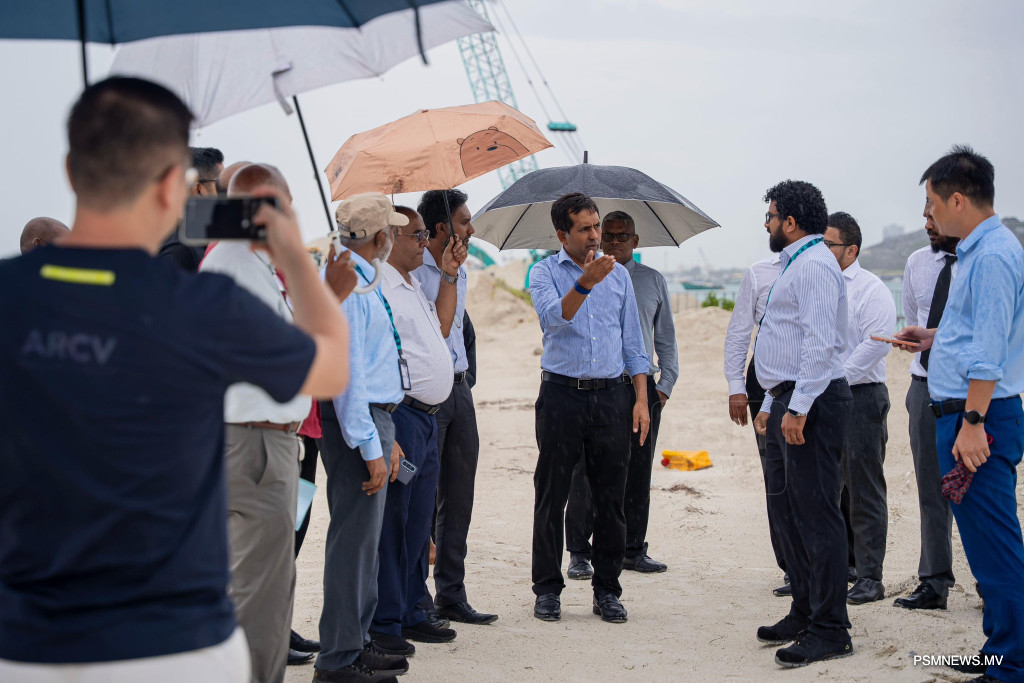
The Minister of Economic Development, Transport and Trade, Mohamed Saeed, has announced that the digital framework "Maldives 2.0" will serve as the central operating tool for the nation's new main commercial port currently being built in Thilafushi.
Speaking in an exclusive interview with PSM News, Minister Saeed emphasised that the relocation of the Male’ Commercial Harbour to Thilafushi is the largest and highest-priority project being undertaken by the current administration. The government has highlighted the mega-project as a transformative initiative poised to drive unprecedented growth in the Maldivian economy.
According to Minister Saeed, the relocation is designed with long-term foresight. As 80 percent of the Male’ Commercial Harbour’s current operations shift to Thilafushi, key entities—including Maldives Ports Limited (MPL), Maldives Customs Service, and other relevant state institutions—will also move their operations to the new hub. The relocation will pave the way for highly modernised, digitised, and top-tier services that rival major international ports.
"In establishing this system, the President’s instruction is that as the port is built to modern standards, the software running the port and all related functions should be integrated using 2.0 to ensure seamless operations," Minister Saeed said.
"That means making Maldives 2.0 the central operating tool and connecting the entire governance framework within it."
The physical infrastructure of the new port is being scaled up significantly to meet global standards. The international quay wall will be extended to around 1.2 kilometers, allowing the facility to service three to four large vessels simultaneously.
Additionally, the project aims to resolve severe space constraints currently plaguing domestic maritime operations. By addressing these bottlenecks, the new terminal will eliminate the heavy expenses local businesses incur when vessels are forced to stay anchored for days waiting to berth. To provide a holistic solution, the government plans to establish a comprehensive network of warehouses, storage facilities, and retail spaces inspired by the "Atoll Shops" model.
The economic benefits of the transition are expected to be felt directly by consumers. Minister Saeed noted that faster clearance times will prevent fruits, vegetables, and other essential perishables from spoiling, ensuring they reach market shelves fresh. Consequently, the rapid turnaround of imported cargo is anticipated to drive down retail prices for consumers.
Designed as a state-of-the-art, multi-purpose facility, the Thilafushi port will lay the foundation for a 24-hour, non-stop logistics ecosystem. While the first phase of port services is scheduled to transition to Thilafushi this October, the government aims to complete the full relocation of all commercial port operations before November of next year.