

The National Social Protection Agency (NSPA) had 535 thalassaemia patients on its registry by the end of August, according to statistics published by the agency.
NSPA registered four more children during August. Registrations have continued to increase following the introduction of a special allowance for children undergoing treatment for thalassaemia.
NSPA statistics show that 535 people were registered with the agency, while about USD 69,390 was disbursed during August alone.
Separate statistics from Maldivian Blood Services show that 981 people have been registered in the Maldives as people who receive blood transfusions. Of those registered, 668 were alive as of 4 August.
The geographical breakdown shows that most of the 668 people live in the atolls, where 505 are registered, compared with 163 in the Malé region. The register comprises 319 males and 349 females.
Those aged between 11 and 20 make up the largest age group, with 215 people, followed by those aged between 21 and 30.
By population, Noonu Atoll has the highest proportion of people with thalassaemia. The register includes 53 people from 13 islands in the atoll, equivalent to an average of four people per island.
Faafu Atoll has 18 people on the register, while Laamu Atoll has 43. Vaavu Atoll has no registered thalassaemia patients, while Meemu Atoll has the second-lowest number, with three.
The Government has introduced several measures to raise public awareness of thalassaemia and address the increasing prevalence of the condition. One of the key measures involves screening schoolchildren for thalassaemia.
The Government has also increased the number of children receiving Government-funded bone marrow transplants as part of thalassaemia treatment.
As part of efforts to support people with thalassaemia, the Government has begun providing Maldivian Blood Services at Orange Hiyaa in Hulhumalé under the Malé City Group of Hospitals. It has also established a DNA laboratory to provide various thalassaemia tests.
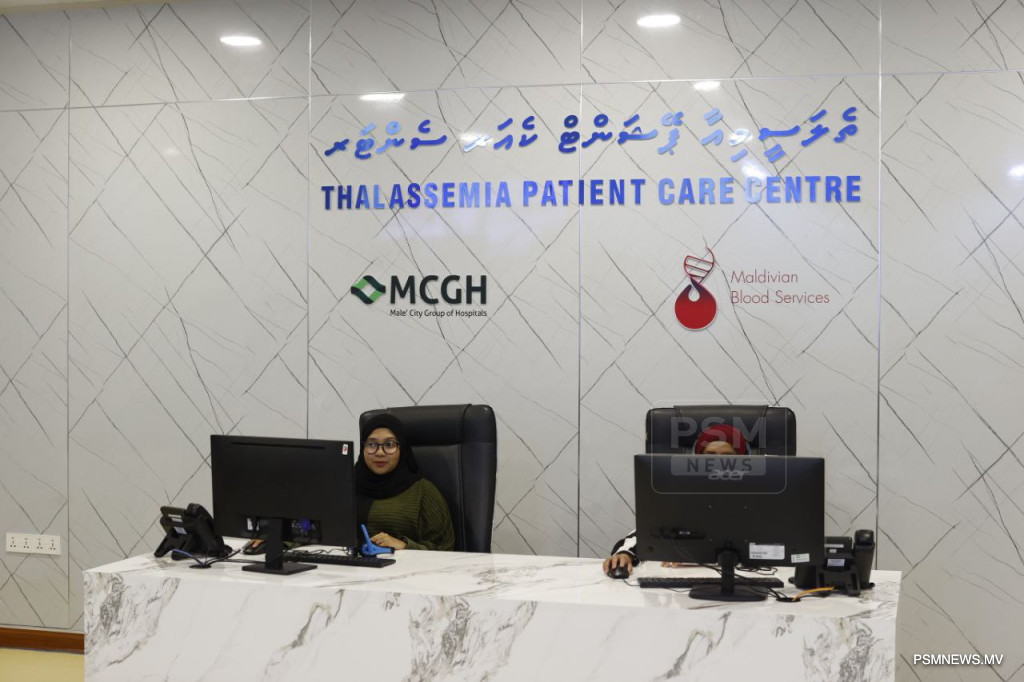
The services also include endocrinology, internal medicine and haematology clinics, as well as services through the Thalassaemia Patient Care Centre.
Further measures include free bone marrow transplant treatment. The Government has decided to support 10 children each year to undergo bone marrow transplants over a five-year period.
The initiative will support 50 children over five years at a total cost of about USD 3.24 million. In addition, the Government has begun providing children with thalassaemia with an allowance of about USD 130.